
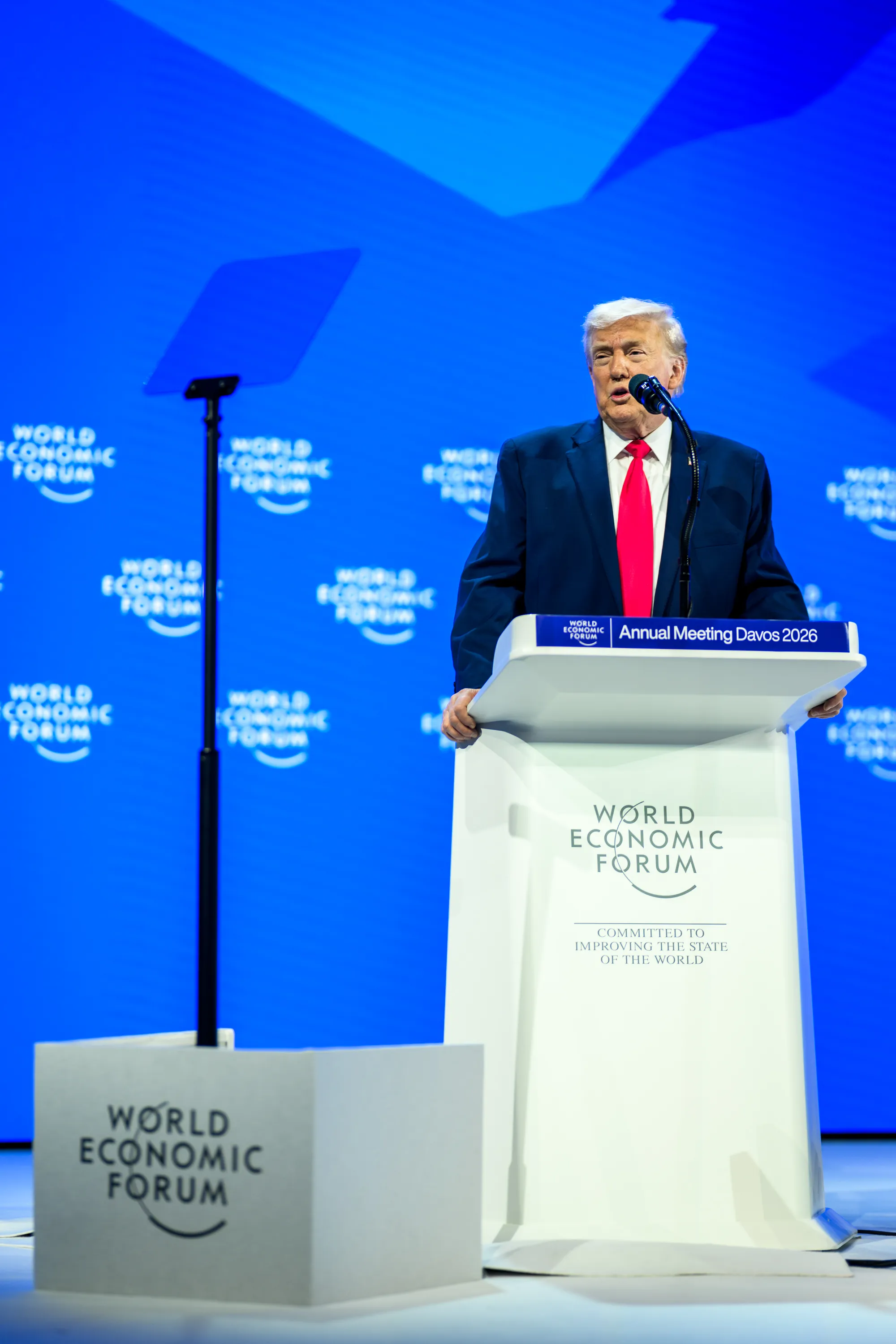
The President went to Davos on Wednesday and gave a speech for one hour and four minutes. In the middle of the speech, gently, on the way past, between a complaint about NATO and an aside about wind farms, he said that he would not use military force to acquire Greenland.
Hon. That is the news.
That is also, on its own, a useful piece of news. The four-day stretch where the President of the United States was leaving the door open to a military invasion of an autonomous territory of an ally is, on Wednesday afternoon, over. The relief in eight European foreign ministries was audible in the press releases.
The phrase the President used, after meeting with the NATO Secretary General Mark Rutte at the conference, was that the two of them had “formed the framework of a future deal.” The framework. Of a future deal. A future deal that, on Tuesday, was going to be backed by ten percent tariffs on eight allies. The same future deal is now going to be the topic of negotiations conducted by the Vice President, the Secretary of State, the Special Envoy, and other officials, all reporting directly to the President.
You ever notice how, when somebody walks into a room with a baseball bat and then walks out without the bat, the room treats it like a courtesy. That is what Davos was. The President arrived in Switzerland with a tariff threat against eight countries and walked out with a we are no longer threatening eight countries. The Norwegian foreign minister, on the side, called it “a return to talking like grown-ups.” That phrase is the verbal Norwegian equivalent of thank you for not setting the building on fire.
The same speech also contained the line that the United States would be “unstoppable” if it did, in the future, use force. That is the part of the speech that’s not in the press releases. The standing line. The standing line, in Davos, is the part the cameras don’t keep on B-roll.
Look. The pivot is real and the tariffs are off and the Danish prime minister got to sleep on Wednesday night. That’s a result. I’d rather a country that does the threat-and-walk-back than the country that does the threat-and-keep-going. Out of the two bad choices.
But you have to count the trick at the same time as the relief. The President made the threat himself. The President made the deal himself. The President is now selling himself the credit for not doing the thing he said he was going to do. That is the oldest sales technique in the book. The man at the end of the bar tells you the whiskey costs ninety dollars. You wince. He says, for you, fifty. You say thank you, you go home, you tell your friends about the fifty-dollar whiskey, and the whiskey was twenty.
That ought to concern you.
The breakdown.
- Factual basis The reversal is real. The 'framework' is, as of Wednesday night, a word.12/25
- Self-awareness He said the United States would be 'unstoppable' if it did use force, in the same speech.7/20
- Staff containment Vance, Rubio, and Witkoff named as the negotiating team after the fact.9/20
- Recovery attempt The same speech contained the recovery and the original threat.8/15
- Public spectacle Carried live across Europe.14/20
Was this dumb enough?
Members can adjust the score. Become a member.